MARIO AMURA
Napoli, 1973
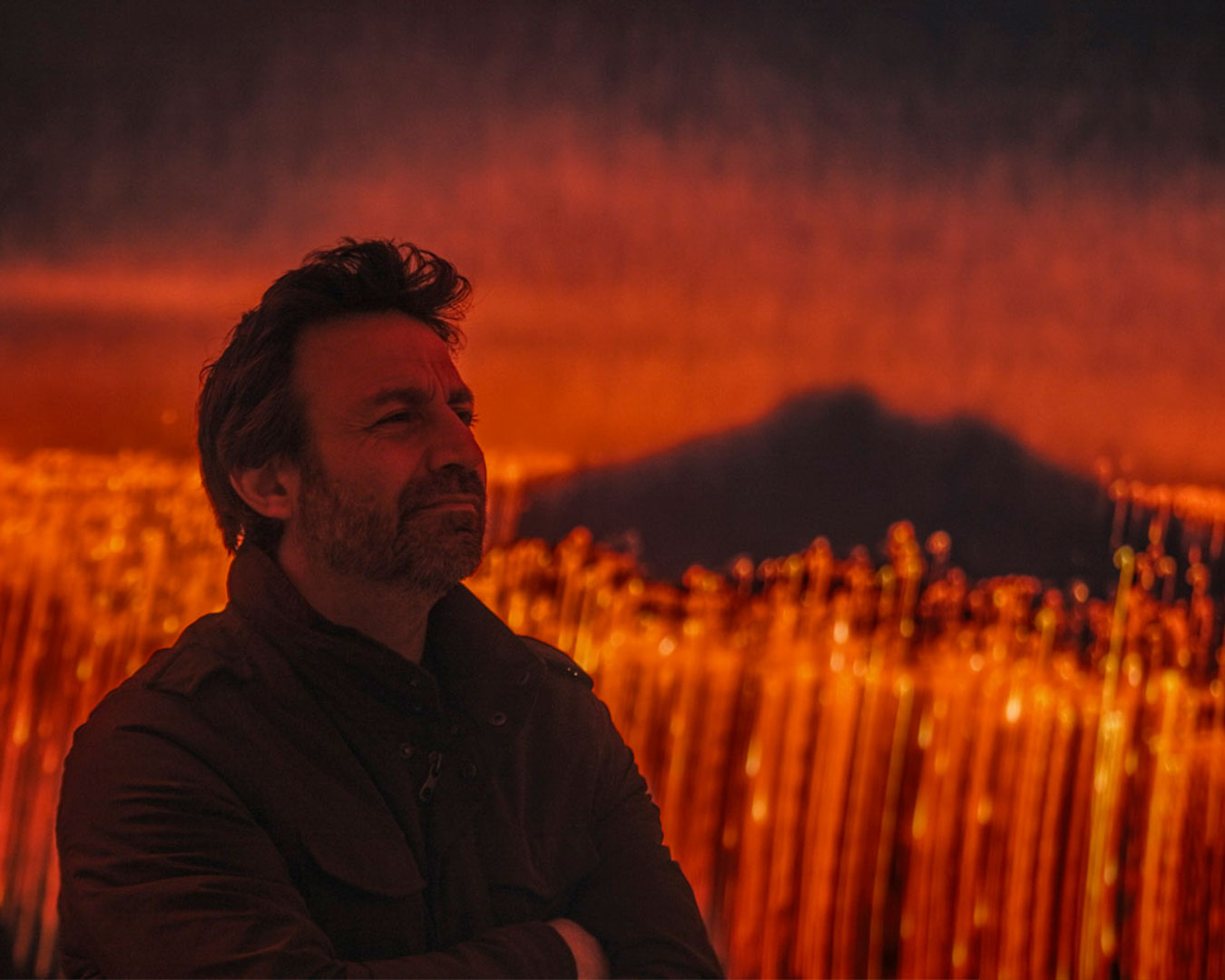
Mario Amura on Napoli Explosion
When did the Napoli Explosion project come about? What is its origin?
I lived in Torre Annunziata until I was 18. My bedroom window overlooked Vesuvius, and every morning I respectfully whispered to him good morning – as you do when someone is asleep and you fear waking him up. The volcano is a living presence for anyone who lives on its slopes. In 2006, I celebrated New Year’s Eve on the heights of the volcano, among the pines on the side facing Naples. Witnessing – while feeling the heat – the euphoria of explosions and fireworks at the stroke of midnight, the energy of the magma chamber under my feet made me feel there must be a link between those ephemeral explosions I was observing in front of me and the people’s fear that the dormant power of the volcano would explode. On New Year’s Eve 2010, I witnessed the celebrations for the first time from the top of Faito, the mountain that stands out on the Gulf of Naples in front of Vesuvius. That night and from that perspective, the scenario that opened up before me seemed to subvert the classic iconography of gouaches or masterpieces by Turner, Wright, Volaire, Marlow, and Warhol. They depict the erupting volcano coloured by the lava flooding it. Vesuvius appeared as a silent shadow immersed in a landscape that seemed to explode around it.

How many times have you gone back to this ritual, and why?
I have been up the Faito every New Year’s Eve since 2010. From that position, the breathtaking spectacle of hundreds of thousands of fireworks exploding at the same time confuses the perception of microcosm and macrocosm. Returning there has become an obsession.
Over time, it is as if I have refined a sensitivity in interpreting the state of mind of the Vesuvian people, in their propitiatory rite at the beginning of the year. It felt as if I could recognise the motions of hope, fear, joy, and anger, according to how they decided to shoot firecrackers and fireworks. It is a little like what happens in the play Le voci di dentro by Eduardo De Filippo where the elderly Zi’ Nicola has given up speaking and expresses himself by shooting firecrackers. The hero of the play, Alberto Saporito, has learned to decode what Zi’ Nicola tells him.
I keep going back to that mountain every year for a more intimate reason. Napoli Explosion is a photographic project that my father was fond of. Since he died, I have returned to this ritual to reconnect with him.
In Paesaggio Civile (Il Saggiatore, 2022), Serenella Iovino writes: ‘This year I have seen more poverty and more anger,’ Mario told me about New Year’s Eve 2016, commenting on the photos of a difficult year for Italy and Naples. Even the transition between 2020 and 2021, after the first year of Covid, was a story in itself: ‘White lights. Zero noise’. What might seem like a repetitive experience changes every time, and each time the photograph captures the synchrony of a gigantic exorcism against the inhuman forces – the volcano, destiny – that dwell in this place.
How many people are in the staff group that follow you on your expeditions?
The team of operators who ascend with me are not professional photographers. They are my partner Claudia Ascione and some of my dearest friends who have become passionate about the project over the years: Christian Arpaia, Serafino Murri, Gennaro Santamaria and Maurizio Valsania, while Serenella Iovino supports us and collects memories. The production team is coordinated by Raffaele Losco, and Carla Santamaria is in charge of logistics. Once we had descended, another working group contributed to the development of the project comprising Mario Nucibello, Cristina Ascione and Angelo Faella.
About personnel, Serafino Murri writes:
It is no coincidence that the photographers Mario has surrounded himself with over time are not professionals, but intellectuals, people who do not use photography as their main expressive vehicle. The ego, in this project as in all rituals, disappears. In rituals – think of prayer – voices are confused, and there is a single mystical drive. That is the strength of something determined to act against the dark laws of the cosmos, against fear. It generates emotions that cannot be circumscribed.
Mario assigns precise technical instructions to his photographers, such as exposure times, lenses to be employed, areas to be framed. But he also issues instructions, such as ‘put your leg here’, or ‘make this movement’, as in a sort of choreography. During the shots, I felt like a dancer in the hands of a Roland Petit telling me to ‘do a pirouette’. I didn’t understand why, but the point was just this: stop looking for a ‘why’ and carry on dancing – camera in hand – on Faito’s top, in the cold and dark, to nourish a spirit guide, irreverent and ‘light-hearted’. This is a spirit that feeds the Neapolitans who, on New Year’s Eve, avert the eruption of Vesuvius by firing their botti with sinister joy.

Il team di Napoli Explosion sul Monte Faito
Where are you staying? Is there a convivial moment?
New Year’s Eve remains a time of celebration for everyone, and everyone needs to see off the year with a toast. The blessing of being among friends allows you to joyfully share the whole day of 31 December, even while staying focused. Over the years, we have organised dinners at my house in Torre Annunziata, but also in an osteria, or at the Santamarias’ on Faito. In the year of Covid, we ate al fresco, but always together. Even if slightly early, the celebration unites us and makes us all part of a journey that we feel is wonderfully unique.
In the weeks leading up to the event, I share an operational strategy document with individual assignments of tasks, technical equipment and challenges for that year. This document becomes an object of inquiry in various collective or one-on-one meetings. At this stage, a soundtrack serving an emotional mood is chosen. Each operator is assigned a ‘visual score’, paired with one of the musical instruments used in the soundtrack.
Serafino Murri writes:
Resembling cinema, Mario’s contribution during the photographic expeditions is above all ‘musical’. When I say musical, I mean just as if it was the organisation – in a literal and technical sense – of a symphony. In a symphony, a too-long or not marked enough note is disharmonic. You have to listen and act in concert. This was the case for the Napoli Explosion crew. Mario was a conductor who coordinated all the voices of the individual instruments. Such a need for collective action – which I believe stems from his experience of cinematic sets – is a substantial component of the creative process of Napoli Explosion.
What is the goal of your project now? Were you clear about the purpose and the formal result from the beginning?
Right from the start, I tried to show the link between Neapolitans and Vesuvius through contrast, immortalising the city exploding while the volcano is silent. Over the years, I have indulged in an obsessive search for an icon of Vesuvius that is not stereotyped or hackneyed. I was searching for a vision that would unseat the gaze from expectations. The image of the black, silent silhouette of the volcano flooded by the fireworks’ chromatic tumult seemed a representation that had to be seriously pursued, and in many ways. The only certainties were the two limits I imposed on myself from the beginning, and which defined the field of action. The first was to respect the principles of photographic reportage in digital post-production by limiting the intervention to what, in the past, was possible to obtain in the darkroom. Respecting what has been collected during the shooting phase ‘from life’ offers the unique thrill of expressing yourself through something aside from the self. That means fixing what happens autonomously in an image by simply extracting it from the temporal continuum. The reportage photographer reads reality via a single, decisive choice: determining a point of view. The second limit is about the point of view I have set myself: always shooting from the same vantage point, from the top of Mount Faito. The concrete experience of filming Napoli Explosionis resolved in a few minutes a year: from midnight to 15 minutes past midnight. Leaving my vantage point unchanged has allowed me to adjust the shot according to the analysis of the results of previous expeditions made during the rest of the year. Over the years, the creative process has gone beyond the representation of reality and is in search of new frontiers or new affinities between photography and painting. The project began with trying to capture a different image of Vesuvius and evolved into an experimentation of new forms of writing with light, using a unique colour palette provided by the hundreds of thousands of fireworks that exploded at the same time.
Napoli Explosion has become a quest for the sentiment of light.

Mario Amura al Real Albergo dei Poveri – NAPEX 241001
Biography
Mario Amura is an Italian photographer. Since the 1990s he has sought in photography a way of embracing reality and making its emotions perceptible. His projects mature through long periods of observation and turn to collective rituals, in which a community gives form to its own fears and desires.
His research explores the relationship between light, time and perception. Taking up the experiments of chronophotography and photodynamism, he develops their possibilities in reportage and in the interactive image. The images are made entirely in camera: framing, exposure time and camera movement turn luminous traces into painterly compositions, while post-production is limited to colour correction. They remain photographs of a real event.
He graduated in Law from the University of Naples and trained at the Centro Sperimentale di Cinematografia in Rome under Giuseppe Rotunno, from whom he inherited the idea of a gaze that puts itself at the service of what it tells. Between 2000 and 2012 he worked alongside photography as a cinematographer and director, on films shown in Venice, Berlin and Cannes. Today his research is entirely photographic.
In StopEmotion, begun in 2005 and still unpublished, photographic sequences gathered in several countries become visual scores to be performed live to music. In Napoli Explosion, begun in 2010, every New Year’s Eve Amura photographs from Monte Faito the fireworks with which Neapolitans exorcise their fear of Vesuvius: movement and the duration of the exposure turn a real event into images suspended between figuration and abstraction. The project has been shown at the Museo e Real Bosco di Capodimonte, at the Real Albergo dei Poveri and in Rio de Janeiro, and has entered public collections. His new cycle on Carnevale di Rio de Janeiro, still unpublished, extends this attention to another great collective ritual.

Mario Amura, 1999 – Foto di Zofia Sobociński